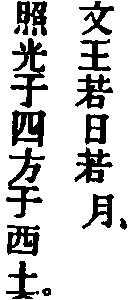
"King Wan dreamt that he was clothed with the sun and the moon. A phoenix duck sang on mount K'e. In the first month of spring, on the 6th day, the five planets had a conjunction in Fang. Afterwards a male and female phoenix went about Wan's capital with a writing in their beaks, which said: 'The emperor of Yin has no principle, but oppresses and disorders the empire. The great decree is removed: Yin cannot enjoy it longer. The powerful spirits of earth have left it; all the spirits are whistled away. The conjunction of the five planets in Fang brightens all within the four seas.'" The Annals of the Bamboo Books, Part V the Dynasty of Chow, The Chinese Classics
"In Wending's 12th year, phoenixes collected on mount K'e." Note: This was the first year of king Wan. The Chinese Classics. p.138.
Phoenixes may have been seen with the setting sun on China that stood still at noon for the battle of Merom. Thus king Wan may have had more light to fight the Shang dynasty that day. All because God made the day longer for Joshua to fight the battle of Merom that day.
"35th year of king Wen of Zhou, 1st month, day bingzi 13, during worship of the full moon the king announced, 'The many...eclipses are untimely, you should begin planning for the succession.'" Yi Zhou shu. Xiao kai jie. ch.17
This must be the lunar eclipse visible just after sunset in China September 23, 1205 BC on day 13 of cycle 60 the first month beginning in September.
Then the lunar eclipse September 24, 1205 BC that was counted as in king Wan's 35th year was actually his 36th year, 35 and a half years had gone by.
This means king Wan's dream may be February 5, 1239 BC, his 35th year this September 23, 1205 BC. Then all these dates should be 14 days earlier = the moon setting at noon in the west in the Ajalon Valley at Joshua's long day, instead of the moon rising in the east on Joshua's long day.
There may have been a sun miracle Friday, May 9, 1206 BC on the 13th day of the first lunar month of spring in king Wan's 35th year. The 13th day of the lunar month thus seemed a day early for a lunar eclipse and thus was interpreted as a sign by king Wan of his appointment of heaven. Then a sun miracle again on Sunday May 11 and earth flowed back in a reverse orbit 189 days to the sun miracle November 16, 1206 BC. Thus the sun miracle November 16, 1207 BC previous being cause for king Wan to declare "these many eclipses" as a sign of a new dynasty at the sun miracle on day 13, May 9, 1206 BC in king Wan's 35th year. Then, it was a the lunar eclipse September 23, 1205 BC a year later that king Wan made his statement, sun miracles and eclipses being too many signs from heaven.
Planetary simulations during Wan's lifetime do not show such a conjunction. Perhaps what is meant is Jupiter and Saturn moved 180° from Scorpius to Taurus. Mercury and Venus are close to the sun and can be in Scorpius in February only if the sun moved 180° from Virgo/Scorpius/Fang in February to Pisces. Then this sun miracle may be the sun moving back 180° and earth flowing out of the reverse orbit of the sun. Then the five planets were moved out of the way of the sun as it moved and appeared to be in conjunction gathered together in a "pit" as at other sun miracles.
Then the five would appear in the night sky as the day before, only with different background stars. Earth must flow out of a reverse orbit that day, perhaps February 15, 1240 BC. "all the spirits are whistled away" may refer to strong winds that resulted either from weather changes. The sun must move 180° back half a year later for earth to flow out of the reverse orbit and reorient and continue as if nothing happened. Only there are adjustments that are only complete after a full year of reverse orbit. If the sun moved 180° west February 17, 1241 BC for an early Saturday morning on Jericho, when Joshua attacked at the trumpet the seventh time around the city. Then earth must flow into a reverse orbit of the sun and the sun move up or down to keep earth in the same season.
Likewise if the sun moved back the night of August 23, 1241 BC the sun must move to the August 16 inclination of the earth. August 16 the sun could move back without a trace in earth's orbit. The summer half of the year is longer than the winter half because earth's elliptical orbit takes earth further away from the sun in summer thus earth's orbit is slower. Meaning there are 186.4 days in the summer half of the year and 178.8 days in the winter half as marked by the equinoxes. 186.4 + 178.8 = 365.2. Then if these sun miracles were all on Saturday; August 24, 1241 BC was 188 days later.
Likewise, if there was a sun miracle at the crossing of the Jordan River on dry land the 10th day the first month, Sunday, February 4, 1241 BC, 188 days later is Saturday, August 10, 1241 BC.
Or this would be the six day moon of August 24, 1241 BC. The sun may have suddenly risen in the west at 11 PM August 23, 1241 BC for a sudden surprise sunrise on Sisera and the Midianites for Deborah and Barak and Gideon - Judges 4,5,6,7,8. This would end the first half reverse orbit. Then the sun must suddenly rise in the east and perhaps be several times brighter to leave the same daily coral line. This would begin the second half reverse orbit. Then at the anniversary of Joshua's long day the sun must stand still at noon again on Israel for Joshua's surprise attack at Merom Saturday, February 15, 1240 BC. Thus the sun returned back without a trace.
"Uncle E-ho, how illustrious were Wan and Woo! Carefully did they illustrate their virtue, till it rose brightly on high, and the fame of it was widely diffused here below. Therefore did God cause his favouring decree to light upon king Wan." The books of Chow, Book XXVIII, Chinese Classics
Three hundred years after king Wan's birth, this portent, most certainly Joshua's long day, was still being talked about. The characters here of the sun and moon, translated illustrious, probably refer to what China observed when Joshua commanded the sun and moon to be still. Here the credit is given to God. You can see the character for Shangdi the same character for God  used first by Shun to describe the "chief of the four mountains" in Shun's Canon.
"In his (emperor Te-sin's 1178 BC) 48th year, the E goat (spirit like animal - exciting wonder) - was seen. Two suns appeared together." The exciting E-goat could be the qilin the phoenix. Perhaps they looked directly at the sun to see the angel of the sun. Do not look at the sun or it will cause irreversible eye damage. Perhaps the sun moved 180° daylight lasting two days, 24 hours, like the sun when it stood still for Joshua. A similar sun miracle to Joshua's long day may have been associated with Woo who became emperor 1174 BC. Thus his appointment from Heaven. There may have been a sun miracle in the same month Wu receceived the mandate from heaven - before May 1174 BC.
"How illustrious were Wan and Woo!" Literally: How Sun and Moon were Wan and Woo! There may have been a sun miracle early 1122 BC when Woo, Wu, was conquering China and was quoted by the Duke of Lu Yang in 470 BC when the setting sun rose in the west on China and reversed three solar mansions. This does not look like a solar eclipse.